June 26, 2011

Ah, Paris.


Dijon
Having descended from our alpine adventure, we set our sights north. After a botched attempt to find a hotel or hostel room in Lyon, we found ourselves at a campsite in the Beaujolais region of France - home to many a world-renowned vineyard. We took the time on our way out of the area the next morning to drive along the tiny back roads, taking in the rolling hills of vines laid out one after another after another, spreading into a wonderfully rhythmic vista of perfect green rows that are finished here and there with a bright rosebush.


We spent the afternoon wandering the small city of Dijon. The city centre is quite pretty, and we spent some time in the fine art museum which is housed in the gorgeous old ducal palace of Burgandy. And obviously we bought mustard, which is Dan's favourite food. At the end of the night, we had our most elaborate meal yet - escargot (in an adventurous moment) and fish for me, beef bourginon for Dan. At 60€, it was also thus far our most expensive meal.

The next day we meandered north through the back roads and eventually found Meaux, where we said goodbye to our beloved steed and without mentioning that we had definitely ruined the breaks, grabbed a train to Paris.

Along the way, we found the source
of the mighty River Seine: this tiny
stream, bubbling up through the grass.
Paris did not disappoint. Glamorous and gritty, authentic and overwhelmingly touristy, Paris is everything it promises to be. Both the hostels we stayed at were in Montmartre - the hill looming in the north, and in the late nineteenth century, the haunt of the city's artistic community. (Our first hostel was just a few doors down from a house once owned by Vincent Van Gogh's brother, where the artist stayed early in his career.)


In our four-and-a-half days in the city, we were able to see a number of major attractions. We climbed up to the Sacre Coeur, the basilica commanding a phenomenal view from the top of the Montmartre hill. We walked out to the Père Lachaise cemetery,where we visited the graves of Oscar Wilde, Proust and Jim Morrison, wandering among the tombs both broken and dilapidated and dutifully preserved, the tree-lined avenues creating gentle quiet despite the tourists flitting about on their various homages.

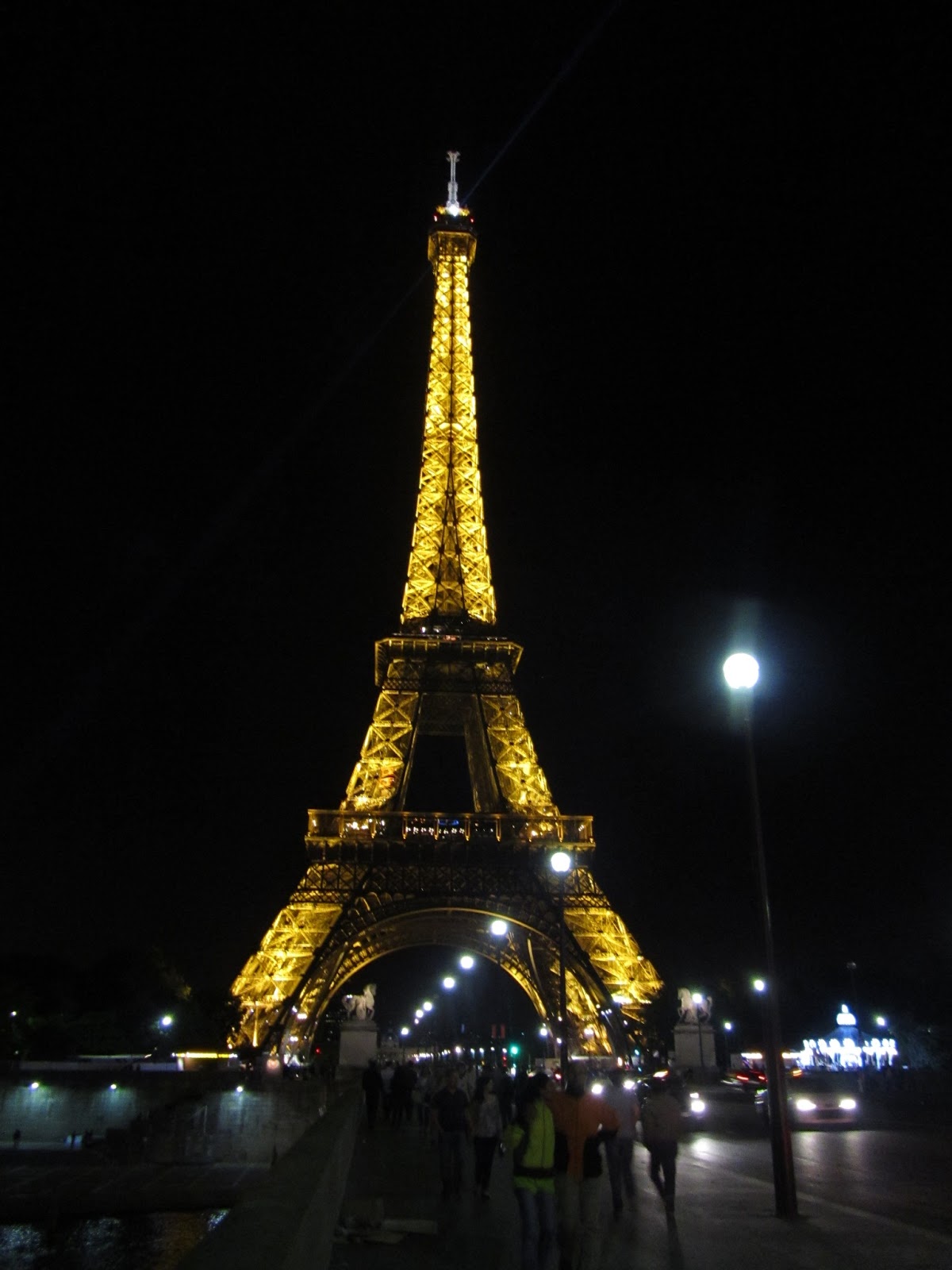
We walked through the gardens and the courtyard of the Louvre, admiring the intricate details of the grand architecture, but in as I'd been inside the museum on my last visit to Paris, and we are both very interested in impressionist and post-impressionist art, we opted to spend a day exploring the much more manageable Musée d'Orsay. We did the same with Notre Dame, the Arc de Triumph and the Eiffel Tower - admired each from the ground without paying to go in or up.
The morning of Friday the 20th of May, we met my parents at Gare du Nord and checked into our new hotel. After a brief time to settle in, we began our week-long historical voyage.

Throughout my childhood, many of our vacations involved either the family hobby of historical re-enacting, or visits to colonial forts and battlefields from every North American war or a combination. This would be no different. (Although at 24, I certainly enjoy and seek out these sites and museums more than I'd once thought I would. For me thirteen-year-old self, this would have been a painful trial)

In the hall of mirrors
We started by visiting the tomb of Napoleon at the Musée d'Armée, taking in as well the exhibits of medieval suits of armour. Our final day in Paris, leaving Dan behind nursing a cold, we ventured out to the palace of Versailles. The first part of the afternoon, I spent with my Mom and Dad wandering through the elaborate, never-ending splendor of the gardens. We wandered through the series of small gardens, sheltered by hedges and each centered on a sculpted fountain, through the breezy tree-lined boulevards, and by the giant expanse of the grand canal. I left them to enjoy the whimsical madness of Marie Antoinette's fake peasant village while I made my way back to the palace to find Dan. We explored the palace in the late afternoon - unbelievably elaborate, crowned by the hall of mirrors, dazzling in its excess with hundreds of gold-rimmed mirrors and gold-covered statues, throwing the light around the room to beautiful effect.

The next morning, we picked up a car at Gare du Nord. Although this time it was Dad driving, I was back in the navigator's seat with my trusty atlas of France in my lap - thankfully, though, sandwich making duties had now been delegated to the back seat. With minimal agony we found our way out of Paris and we were headed northwest to Normandy.

S.

June 15, 2011

The Road Trip: Alps


We left our linguistic comfort zone behind as we crossed into Italy, heading immediately north along the border and then east, passing just over Milan. In the alpine foothills, we stopped to stock up on two super-greasy pizzas and three magnums of red wine (you cannot be too prepared), and then off we went towards the northern border and the dizzy, snowy heights of the Alps.

That night we drank the first magnum at our campsite perched on a cliff over top of a valley town in Northern Italy with a magnificent view of the nearby peaks. Amid the thick, muffled forest, it's certainly easy to imagine how strange noises could spawn fairy tales and how rumours could attain a legendary quality. Even now, many of the mountain passes close for the entire winter. Although tunnels make the alpine villages much more accessible than in years past, the weight of isolation is easy to feel.

The next morning we packed up and set off into the alps. We had aimed for the famous Stelvio pass in the northern reaches of Lombardia, but after a morning of creative route-making through past the stone houses of a tiny alpine town (what happens when the navigator is also the designated nutella sandwich maker) we found that even in mid-May, the pass was closed.

So we picked our way back west through a different pass, had a delicious pizza lunch at a family-run restaurant at 2000 m altitude, and crossed into Switzerland. We gazed, awestruck, at the Swiss section of the alps - the highest and most picturesquely snowy we'd seen, and then promptly crossed the border into Austria.

We stopped for the night in the Austrian town of Kufstein, a mere four km from the German border and the base for some excellent and accessible hiking. Kufstein is adorably kitchy, complete with a smallish white castle on a hilltop in the middle of town and a medieval section with lederhosen for sale and similarly themed murals on the street walls.

We rose early the next morning and took a chairlift high up between a set of peaks that sits nestled in the Kaiser range - specifically Wilderkaiser and Zahmerkaiser, climbed up a peak in the middle and then walked for hours along the valley that links them. During a dizzying descent full of tiny rock stairs, rebar handholds,  and steep cliffs we watched as a chamonix, the alpine mountain goat, charged down the mountain side, darting nimbly among the trees and rocks and deadly drops.

Leaving Kufstein, we spent four days wandering southern Germany. Although we decided it would be too complicated to see Munich with a car to deal with, we spent a sombre morning learning about Nazi atrocities at the Dachau concentration camp memorial, and then after an afternoon of driving, admired the fabulous exterior of King Ludwig II's Neuschwanstein castle. We camped near Stuttgart and spent a day in the car museums - Dan made it to both Mercedes-Benz and Porsche, I only managed the first. Which was very informative and well-organized and even interesting, although by the end I was car'd out.

Our final two German days we spent in the Schwarzwald - the Black Forest, named for its black pines. We hiked around a mountaintop and down into the dense forest, and explored the student town of Freiburg, where the medieval centre is in tact (rare in German towns following the bombings in the war) and where I fell deeply in love with currywurst.

Currywurst! Writing in Amsterdam, I'm hesitant to even think about it because the thought makes me hungry. Currywurst is simple - a wurst, or German sausage, sliced up, smothered in bbq sauce and then sprinkled with curry powder. So simple and so delicious.

We drove from the Schwarzwald back into the Alps and back into Switzerland. Rather, through Switzerland. We drove past Interlaken and out to Jungfrau, but in the fog of a rainy day were unable to see past what I would approximate as 2000 m. We had a similar problem with Mont Blanc, once we crossed the French border. Although we could see the fingers of glaciers poking through the mist, that was all.

We were still two nights from Paris, but for our poor little Fiat, we were done the hard part. After a week of alpine adventures, the brakes were now almost done in and smelled awful on descents, but the champ of a car managed to get us safely back to France.

S.

June 11, 2011

The Road Trip: Riviera


Early May, we left Barcelona on a Eurolines bus to France. Originally we had planned to take the train down the Riviera and up to Lyon, where we would rent a car and tour the alps in (compact) style - but given our new time-crunch (expletive directed towards the Schengen Agreement...), we decided to rent the car right at the Spanish - French border and return it just east of Paris 13 days later.

We picked up our sweet steed in the town of Narbonne. While waiting for the car, we discovered a fourteenth century cathedral - although we'd seen churches that claimed to be older, it was really nice to explore the damp, musty interior. Churches are nicer when they aren't tourist traps.

Our car was a Fiat 500, standard transmission. Tiny engine but, as we proved later that week, entirely alp-worthy. The arrangement for our two week rental was that Dan would drive and I would navigate old school - ie with a giant atlas - because we are too cheap for GPS.

Enormous bridge at Meyruis, Parc des Cevannes.
From Narbonne, we drove north into the Pyrenees to the Cevannes National Park, a former tableland that has been gouged out by rivers into a series of long peaks and deep gorges that make for phenomenal hiking and exciting driving, if you're into whipping around one-and-a-half lane roads and cliffs and near death experiences. Cough, cough, Dan.

We stayed at a nearly empty campground and that night thanked our lucky stars that we had invested in a puffy, 7€ comforter for the duration of the road trip, because the temperature that night fell to nearly zero degrees Celsius. Wrapped up in layers and our fleece blankets and the comforter, after a bottle of red wine, we made it through the night warm and happy.

The next day we got hiking information at the tourist office in nearby Florac and hiked up one of the peaks. As our first climb in a couple weeks we were easily winded, but the view over the hills and gorges was worth the thigh pain.


From the Cevannes, we drove high up along a long peak and then descended into Avignon, which is pretty, but expensive, and then to Arles. As the city is famous primarily for being home to Vincent Van Gogh for over a year, we couldn't help but take a Van Gogh tour to see the original buildings and landscapes he spent the year painting. We also toured through the Roman colosseum, which is still used today for non-lethal bullfights.


The view of Arles from the colosseum
We drove along the French Riviera, encountering navigational difficulty only when we accidentally ended up in chaotic Marseilles, generally avoiding the cities and sticking to the small, winding roads along the coast. Even in May, the water is turquoise and inviting, the beaches are covered with sunbathers and screeching children and the cliffs in the background are stunningly picturesque. We stopped for the night just west of St Tropez, back in the woods away from the coast, and then on the Sunday night just west of Nice.

I'd been to Nice before, in 2008 with my best friend Piper, and we had a phenomenal time - coming back and looking for the gorgeous, lively town I expected to show Dan, I was a bit disappointed. If you're not in Nice to party, it seems to be a bit too full of tourists and dirty to be as enjoyable as I remember. Although I'm sure had we gone to the beach early in the day, I'd have spread my towel over the smooth, hot stones and been as content in the Mediterranean sun as I was three years ago. Nice will have to live in my hazy, happy memory.


The beach at Menton, just east of Nice
on the Franco-Italian border.
Dan and I both very much enjoyed being in Southern France. Primary among the reasons, past the usual stuff about the scenery and the food (I love cheese. I LOVE IT.) was the simple fact that we could once again communicate with people past basic needs. Neither of us are fluent in French, but we are both functional, and after just a few days of being surrounded by the language and the culture we were quickly picking our floundering vocabularies back up and chatting, if in a bit of a slow stutter. It is amazing the difference it makes to the travelling experience!

I will have the alpine section of the road trip up in a few days - we miss everyone at home!

S

Parc des Cevannes - sometimes, there's just no rushing the drive.

May 19, 2011

Gypsy Rhythms


There are still two towers guarding the former city walls
Our final week in Spain we spent three days in Valencia and four in Barcelona.

So from Seville we grabbed a nine-hour train to Valencia, where we did two things of note - went to the massive aquarium and went to a flamenco show.

The aquarium, or L'Oceanografic, is the biggest in Europe and is home to thousands of species of fish, birds and aquatic mammals. It has new tanks and lots of english information, which is great because its always a plus when I understand what is going on. It was expensive; but we spent five hours wandering through the exhibits and the various climate displays. The dolphin show was packed with daring tricks that to my knowledge aren't standard in North America - a trainer would have a pair of dolphins throw her up into the air ten or fifteen feet to do flips and dives, for example.

The flamenco show we saw was small. The venue was a gently lit bar full of locals, mostly - the kind of place where performers know their audience. We grabbed a glass of vino tinto and settled into a bench against a side wall as a guitarist, a drummer and a singer took their place on the stage. Flamenco music is beautiful. It's a gypsy art taken to new heights by the Spanish; the intricate rhythms and graceful, yearning melodies pack a powerful, wild sadness.

Just as we'd become resigned to the idea that we would be only seeing a music show, which is common, a woman in a feathery black and white dress joined them sitting on the stage. She looked nervous - maybe she doesn't perform often - but she put on a hell of a show. Swaying to to the rises in the music, twirling her hands and twisting about, then suddenly the stacatto of her heels and her arms snap sharply. As the music became more intense, she beat the crazy rhythms out and swirled and snapped faster - gorgeous. By the end of the show I was standing on the bench to see because the enthusiastic crowd had moved up from the bar and I wanted to watch her feet.


I'd been hesitant about going to a show in Valencia because I'd heard that flamenco is just not the same away from its heartland in the south of Spain. I could not be happier that we stumbled on such an informal, intimate show.

We grabbed a bus the last Saturday afternoon in April and headed to Barcelona, only a four hour ride and on a decently comfortable bus.

We'd heard a lot about the pickpockets in Barcelona - a few years ago there was apparently a real problem, and even today it isn't safe to take too many valubles out onto the streets. dan noticed a couple of guys watching me closely when we first got into the metro system with our giant backpacks (obviously holding everything we own...) but we were careful to be aware and over our four days we felt as safe as in any other big city.

Me and Mindy on a tapas mission
The next day we met up with Mindy and Lindsay, who I worked with in Ottawa - Dan and I got day-drunk with Mindy, hopping from bar to bar while we wandered looking for beer and tapas and catching up on each others' adventures. Lindsay's flight didn't make it until late in the evening, at which point her and I got the full Barcelona experience and stayed out til six in the morning talking to Brits and drinking tequila. I was obviously pretty rough the next day, although I didn't have to catch a flight like the girls did. It was so great to see familiar faces - good luck in your travels, ladies!

Sagrada from Park Guell - Just. Massive. 
Barcelona was a great city to wander around - the buildings in the old city are gorgeous and the streets are alive with patios and revelers every day of the week (when the weather is nice!). And the architecture... we spent a full day on Gaudi. We bought day passes for the metro and flitted from site to site to check out the most famous sites - the Sagrada Familia and the Park Guell.

The inside of the Sagrada
The Sagrada Familia is well known as the church that has been under construction since the 1880s (and is certainly nowhere near finished) but the architecture is what astounds people once they get anywhere near it. Two of the three facades on the outside of the building are finished - elaborate illustrations of the life and death of Christ in the form of statues and carvings, overlooked by masive towers, the grandest of which are as yet also unfinished. Gaudi took much of his inspiration from the natural world, so the columns on the inside are designed to appear as trees stretching up to a leafy canopy. The most intricate details are drawn from Gaudi's research into the mechanics of the natural world, and the rejection of straight lines makes for a daring and unique look that stands out in a country already known for its giant cathedrals and elaborate churches.

I feel as if I could spend weeks in Barcelona and barely scratch the surface. I was worried that because I had fallen so in love with Portugal, I wouldn't enjoy Spain, but I worried needlessly. Spain is a stunner and I'd go back in a heartbeat.

S

May 8, 2011

Seville


Seville is every Spanish stereotype you can think of. It unabashedly embraces late nights, wild gypsy music, bullfighting, Flamenco dancing and partying til dawn. It is the hottest place in Europe, literally, and is featured in more operas and stories (think the Barber of Seville and Carmen) than anywhere other Spanish city. And rather than resent these labels, or try to fake an image to live up to them, Seville simply IS the label, with a passionate zeal for life.

Cathedral from the tower


After our evening drinking Sangria on the hostel rooftop, we decided to get some culture into us. We took the hostel`s free (well, tip-based) walking tour and over the course of a four-and-a-half hour ramble through the city, we learned a LOT. What sticks out most to me now was the architecture - Seville`s signature cathedral, one of the biggest in all of Europe, stands where the Islamic mosque stood until the city was captured and Christianized in the 12th century (in fact until a fire a few centuries after the conquest, the cathedral actually just existed in the building of the mosque itself, because the king liked the building).

the organ
The tower that adjoins to the cathedral, called the Giralda, was once the minaret of the old mosque. The windows have the traditional keyhole shapes, and the way to the top of the tower is a ramp rather than stairs so that the man calling everyone to prayer five times a day could ride a donkey up the seventy metres rather than walk.


We went into the cathedral the next day to explore and the thing is huge... the organ alone is over a hundred feet high. The decorations were all made in the colonial era, so there is Peruvian gold all over the elaborate displays. It is stunning.


Ham hocks hanging in a traditional tapas bar
After our walking tour, we jumped right onto the tapas tour, also organized by the hostel. Tapas are small plates of virtually anything... meat platters, mushrooms stuffed with cheese, stews, salads, fish, olives, pig cheeks, eeevvverything. It is essentially how you eat in southern Spain. This tour took us to a traditional tapas bar, the kind with full smoked pig legs hanging from the ceiling, to a more modern place with contemporary dishes, and to one half way between that had amazing tapenade  (on fried bread. So oily. So delicious).

All fed and mildly liqoured, we took off on the bar tour (all tours all day!) led by a leaping madman of a guide. On a Monday night we found decent bars and saw the nightlife districts of Seville. Dan and I left early... at 3:30 am. Seville is a wild, fun city. Dan even danced. Well. Swayed.

The next day we took it easy, explored the cathedral and went out for more tapas for Dan`s birthday dinner. A nice day after a wild party.

S

May 7, 2011

Schengen Woes

As we left our beloved Portugal for Spain, we made two major discoveries.

Rainy hikes near Constantina
The first was that Seville is a great place to go for Easter... if you are not on a budget or if you booked WELL ahead. We did neither and were consequently out of luck. The Easter holy week, Semana Santa, is a huge deal in Seville - it's the biggest celebration in Spain and involves numerous processions  and special events. The hostels that were available were far too expensive, so we put our heads together and decided on a new plan - we would head north and hike in the Andalucian mountains for a few days and come back to Seville when Semana Santa had quieted down. So we grabbed a bus straight out of Seville and north to the Sierra Norte National Park, to the town of Constantina.

We were in Constantina from Thursday til Sunday. It stopped raining briefly after dinner on Friday. We did manage to get a couple good walks in, through the hills with their herds of sheep and goats and through olive groves. It was gorgeous... then it started to rain again.

The sunshine we waited three days to see!
Easter Sunday we caught the bus back to Seville, because in Spain the big hullabulloo all happens on Good Friday rather than Sunday. We had a quiet night at the hostel, indulging in homemade paella and all the sangria we could drink.

On Monday afternoon we went for the hostel`s free walking tour, where courtesy of some new friends, we made shocking discovery number two:

If you are not a European citizen, you are only allowed to be in a certain portion of the EU for 3 months out of any 6. Which, considering we were hoping to spend roughly 5 months in the countries that constitute this zone, is a little frustrating. This is called the Schengen Agreement. Somehow we missed it in our Euro-research!

So the next night we went out for a long dinner, sat down with a map of the EU and a list of Schengen countries, and made a new plan... rather than blow off our plans to meet Dan`s parents in Italy in late September, we just need to exit the zone by late June and not re-enter until our three months are up. This is helped enormously by the fact that Britain, Ireland, Romania and most of the Balkans are not involved.

So despite the wrench in the plan, I am actually now very excited to have the opportunity to explore more of Eastern Europe than we`d originally planned.

S

May 3, 2011

Super-campers on the Algarve


The Algrave in April... bleak, but beautiful
In the morning, in Lisbon, having successfully turned the walking tour into a pub crawl the night before, we shook off our hangovers, swore off sambuca forever and wandered off to the train station with no real plan in mind, other than it was time to head south.

The last minute decision, based on a number of google searches, was that we would head to Lagos, on the western end of the Algarve (the south coast of Portugal) and that we would try camping again. With the help of a knowledgeable cab driver we ended up at Touriscampo, just outside of the small town of Luz, four km from Lagos.

Sagres: next stop, America!
As was the case before, the campground had a small store and a restaurant (expensive this time though...) and this time we even had a pool at our disposal.

We stayed in Luz for three nights, wandering the cliffs that fall into the Atlantic during the day and eating tasty pizza and seafood from the enormous selection of touristy restaurants at night. It seems that the Algrave has a large population of British expats, and as a result the menus can be rather geared towards British tastes (but still retaining the Portuguese finesse in regards to seafood).

We took the bus out to Sagres, which was considered to be the legitimate end of the earth before Columbus happened upon the Americas. It is potentially the windiest place in existence. Set right on the corner of Europe, it's crowned by a fortress that is still in a decent state of repair, and that has a number of interesting displays on Portugal's efforts towards renewable energy. Inspired, clearly, by the wind rushing over the fortress walls, and the fury of the Atlantic beating away at the bottom of the cliffs.

Also it was free, and that was nice.

On Tuesday morning, having survived our first night of rainstorms in the tent (which held up fantastically), we packed ourselved up and hopped a train to Tavira, almost entirely because we were just not prepared to leave Portugal quite yet. We opted to continue camping, and although the new site wasn't quite the luxurious set-up we´d had in Luz, we appreciate the giant canopies over the tent sites because the rain never really quit for the next two days. We were able to explore Tavira´s cute riverside core, as well as its hilltop castle, which has been turned into a (free!) botanical garden. The castle was cute - it was nice to see a different presentation, and the view was great. Although Dan had to spot me on the steep, narrow and slippery staircases up the walls and towers.

And then, sadly, after two nights of rain and dampness in Tavira, we decided that it was time to leave Portugal behind and continue on to Spain - and Seville.

S