Showing posts with label Museums. Show all posts

March 14, 2012

Street Soup

We left our hostel, map in hand, bundled in our fleece sweaters against the cool air of a Hanoi evening in late December. In a show of bravado, we struck out across the street. We jumped back in a panic. We froze for a moment on the curb, watched the scooters whiz by us, the drivers nonchalantly navigating the narrow, congested streets.

Eventually, we made it across that street, then another. Our destination was on the next corner, which was fantastic because Hanoi's lightening fast ribbons of scooter traffic were quickly turning me into a nervous wreck. But we'd made it, and there she was.
Tasty soups at Pho 24 

Perched on a small plastic stool behind a long, low table on the street corner was a middle-aged woman, her graying hair held back in a checkered headscarf, deftly chopping a whole chicken into bite-sized pieces with a thick-bladed machete. The table was loaded with soup ingredients and condiments - chicken parts (yum, feet?), slabs of beef, onions, garlic, noodles, vegetables, herbs, countless unlabeled bottles of sauce - all marinating in the perpetual dust of Hanoi's streets.

We plunked ourselves down on stools, pointed to the beef and said, "two?" holding up the appropriate number of fingers and smiling hopefully. Success! She conferred with the soup tureen boiling away beside her stool, tossed in the meat and veggies, and grinning, handed us two bowls of steaming 'pho bo' - Vietnamese beef noodle soup, which we devoured immediately.


I love pho, and nowhere does it better than a street stall in Hanoi. (Although the Pho 24 chain does a good job too!) This is a city where daily life is out on the sidewalks. Street food is king, storefronts spill right out to the curb. My other favourite experience here was the 'bia hoi,' or fresh beer, stored without preservatives in big kegs and doled out in mugs on corners. The beer line isn't carbonated, like it would be in Canada, and so the tube coming from the bottom of the keg is plugged with a cork - or, when business is good, with the bartender's thumb. Like all other street-side businesses, patrons perch on tiny plastic stools at tiny plastic tables.

My Dad is so proud of me.

We spent five days in Hanoi, mostly eating and drinking (I literally had pho for every meal for about three days. I regret nothing.) but we managed some tourist attractions as well. The military museum has a big display of both Russian and American military equipment that you're allowed to climb on, as well as one-sided displays on both the French and American wars. It wasn't the one side that we're used to hearing about back home, so it was interesting to dig through the propaganda to find a Vietnamese perspective.

The mausoleum: you cannot get closer than this from the front.
Immediately after this was taken, the guards yelled at us to back away.
I also got to see my very first embalmed communist leader! The body of revolutionary leader Ho Chi Minh, or 'Uncle Ho,' is preserved in an enormous mausoleum in Hanoi. To see him, you must walk a half kilometre around and behind the mausoleum itself - by no means can you approach from the front across the parade square. You check your purse at one kiosk and your camera and cell phone at another. Then you walk single file along a thin red carpet into the marble building, under intense scrutiny by Vietnam's tallest military guards, all in spotless white uniforms. You do not talk, or linger, or put your hands in your pockets. Pictures are right out, thus the mandatory camera handover. Everyone shuffles slowly past the pale, waxy-skinned, serene Uncle Ho (who, by the way, wanted specifically to be cremated rather than embalmed and preserved), observes respectfully and emerges from the chilly mausoleum back into the daylight.

Cool, if slightly creepy.

We also checked out a few of the historic temples, and strolled around Hoan Kiem Lake in the old quarter. And then we ate. And ate and ate and ate.

S.

September 11, 2011

Dublin

We took a ferry across the choppy Irish sea from Wales to Dublin on a sleepy Sunday afternoon, joining the late summer crowds of tourists that come here for the pubs, the dance, the history and the Guinness.

The best of our three days in Dublin was actually spent outside of the city. We were invited by our roommates, New Zealand mother and daughter team Marion and Charis, to join them for a drive with an Irishman they'd met - Shane - who, in a show of that famous Irish hospitality, had offered to show them the sights.

The five of us spent the day roaming the countryside. We saw two castles: first Malahide Castle, discretely hidden in a woodland, with spacious grounds that now holds concerts (Prince played there the weekend before).


And after lunch was Trim Castle, where the movie Braveheart was filmed. The walls are in tatters, but the keep at the centre stands tall and the ruins make clear the former grandeur of this place.


We went to to the reconstructed passage tomb of Newgrange, Brú na Boinné in Gaelic, a massive earth mound where the light of day only creeps down the nineteen metre passage to the inner chamber on the morning of the winter solstice, and stays there for less than twenty minutes.


Although they were not, at five thousand years of age, the oldest tombs we'd see in Ireland, it's humbling to know that the curious, swirling artwork was already ancient when the great rocks of Stonehenge were dragged into place.

Carved art at Newgrange
South of Dublin, we drove through the Wicklow Mountains to beautiful Glendalough, where we joined a horde of tourists to snap pictures of the ruined monastery amid the picturesque green mountains. Then we drove by the Powerscourt Gardens and then admired the view of Dublin from a vantage point just south: gorgeous. The day was rounded off with pints at the hostel. Shane made our Irish experience richer with his knowledge and hospitality: thank you, and we'd love to return the generosity in Ottawa!

For our two days in Dublin itself, we did lots of wandering around, and the occasional touristy venture. We visited the Guinness brewery at St. James Gate, the highlights of which were (for me) a display of the company's famous advertising campaigns - Guinness For Strength, Guinness is Good for You and of course, My Goodness, My Guinness! - and a beer in the seventh-story Gravity Bar, boasting a 360 degree view of Dublin.

We got our learn on at the Museum of Archeology, where I learned that the spread of red hair through Europe was the fault of Viking marauders (gotta get me a longboat...).

We relaxed in the lush greenery of St. Stephan's Green, then payed homage to the Dublin literary tradition by finding the statue of expat writer Oscar Wilde in a nearby park, and wandering by St. Patrick's cathedral to see Jonathan Swift's grave (sadly inhibited by high entrance fees). At the time I was reading (grappling with? suffering through?) James Joyce's Ulysses... a third of the way through I took a 'break' and have yet to reopen the dense beast.

We pubcrawled our way around the area south of Temple Bar, but didn't actually eat much pub food - eating out in Dublin is wildly expensive. Instead, we found fantastic kebab and falafel (wrapped in naan bread! Genius!) at Sultan Kebab, and then went back no less than four times. You just can't argue with good kebab.

S.

September 1, 2011

Manchester

We padded gently around the wide, spacious rooms, gazing with respectful envy on the vast collection of leather-bound books laid cozily to rest on the dark, glossy shelves. Down the dusky corridors with their tall, vaulted ceilings were more libraries, waiting with hushed dignity for inquisitive minds.

This is the John Ryland Library, a red brick Victorian-era edifice in central Manchester that was built specifically to house a fabulous and growing private book collection. Now, as well as acting as a library and study area for the University of Manchester, it's a museum, showcasing many important ancient texts and first editions, of which I found most impressive to be a small piece of a Greek bible dated to 125 AD.

Outside the calm of the library, Manchester was vibrant and bustling. A jazz band was ripping up Albert Square in front of the city hall, Piccadilly Garden was blanketed with sleepy sunbathers trying to avoid the inevitable footballs flying about the grass.

When we left the highlands, we spent a few more nights in Glasgow with Piper, as well as her fiancee Danny and his mom Beth, who were visiting from Canada. After a day of intense planning and washing the highland mud out of our clothes, and a tasty meal at the Indian restaurant underneath the apartment (thanks, Beth!), we grabbed a bus to Manchester.

We spent quite a bit of time in the free museums because, well, we like free stuff. Although transport and accommodation can be frustratingly expensive in Britain, many of the excellent museums are entirely free, which is an amazing break for the wallet.

The Imperial War Museum North hit many of the same notes as the other war museums we'd seen in Britain and on the continent, but had a fantastic array of personal stories - to me, these glimpses of humanity during war years are far more gripping than any overriding narrative could be.

The Museum of Science and Industry was also a hit. There is a big collection of both steam and combustion engines, which kept Dan very happy, and the displays about the city's time as the heart of Britain's Industrial Revolution are excellent. Science is fun!

The winner, though, above the informative science bits, was the big exhibit on the evolution of Manchester's sewage systems right from Roman times. Slightly gross, but neat. And we walked through a reproduction sewer that was complete with fake rats.

Just outside the doors of the museum are the physical remnants of the Industrial Revolution:the area known now as Castlefield is full of old rail bridges, big factories and canals.

Although we didn't get to sample any of Manchester's famous nightlife, we did patronize several pubs.

I like British pubs, and so does Dan. I like the bar-style service (rather than table service, and this usually includes ordering food at the bar) because I like the relaxed atmosphere. I love the couches and low tables that make the place feel like a livingroom. Sometimes it actually feels like someone's home: pubs can be a family affair. While we were taking in some afternoon pints at a pub near the science museum, we watched a flock of kids flit between their parents, on the patio, and the park next door. In Tobermory, we watched three generation of family dance to a local cover band. In Cambridge, the proprietor's twelve-year-old son brought out our toasties and did a quality check.

Whether this is good or bad or neither, I don't know, but in the latter two cases it's charming, and undeniably it's part of the pub culture.

S.

August 12, 2011

Cambridge

We passed an uneventful night on the ferry and disembarked in Harwich after a jarring 5:30 wake-up call. After a sleepy morning wandering around the cute and very old town of Colchester, with its Norman keep and Roman ruins, we boarded the train to Cambridge.

Now, I don't know if Cambridge is normally the Bermuda Triangle of British intercity transport, but on the journey in, we spent three hours in Bury St Edmunds because of a blockage on the train track (kudos to the frantic young National Express employee who was simultaneously attempting to explain and re-explain the situation to thirty annoyed and confused passengers who swarmed him incessantly, call cabs to placate said passengers and figure out what the eff was even going on). On the trip from Cambridge to London, our bus dropped all of its oil onto the road two turns into the journey, causing chaos for cycling students and once again leaving us waiting patiently (as we have nowhere to be for nine months) for the next vehicle.

Bit of a shock coming from the slick precision of German and Dutch rail. But maybe we're bad luck. After all, one of our trains in Germany WAS one-and-a-half minutes late.

Either way, we eventually made it to a campsite 5 miles outside Cambridge and set ourselves up. We were in need of a rest, so three nights turned into five and even so, we never did manage to tour the inside of any of the colleges.


We wandered Cambridge's winding streets, lined by quaint black-gabled houses and shops, and walked along the 'Backs,' the long and woodsy park running along the backside of the elaborate colleges. We took a look at the tiny but history-rich Round Church, built as a prayer-stop for medieval pilgrims, and we spent Sunday hiding from the heat, holed up in a pub to watch F1 (Dan) and to devour cheese toasties and use the wifi (me).

We spent a day at yet another war museum, the Duxford Imperial this time, located on the Duxford Airfield, which was a major base in both world wars. As you have probably guessed, it is mostly about airplanes, which thankfully weren't a major feature in Overloon the week before. I will give them this: airplanes are pretty cool.


The highlight of the day came when someone flew their restored Spitfire in loops over the airfield, the droning roar chasing behind the little gray plane as it buzzed down along the grass and then up to flip and fly back down, again and again, loop after loop. We have no idea who owns the plane - the museum can't afford the expense of keeping most of the planes fully functional, but does allow private collectors/pilots to keep historical aircraft in the hangars.


On our final day in Cambridge, we set out on a long hike across the fens - reclaimed marsh land - to Ely, 17 miles or 30 some-odd kilometres away. A long, but very flat walk between the River Cam and the train line, past long, thin house boats covered in windows and plants, families of swans and herds of cows that only begrudgingly moved off of the thick dikes to let us by, sidestepping splatted cow patties as we went.

And then it began to rain, hard and angled in the wind that whipped across the fenlands. We donned our brand-new, ultra-stylish rain pants and tromped on through the muck. Our waterproof shoes began to leak a couple hours later, but there wasn't much to do but sploosh, sploosh, (squish! Cow patty?) along, squinting against the wind and the sharp rain.


Our moment of redemption came when, five hours into the walk and three into the rain, suddenly the massive octagonal stone tower of the Ely Cathedral came into view, beckoning like a lighthouse in a sea of swampy fields. Tragically, we were still five soggy miles off - but now we had a goal in sight.

At least we know the rain pants work?

S.

August 10, 2011

Warning: Does Not Include Robots OR Aliens (or, the Rural Roadtrip to Rotterdam)

Halfway through our time in Amsterdam, we decided that rather than stick to cities for the following week, we would venture farther out into the rural regions. We picked up the cheapest car we could get (a teensy Toyota Aygo) on a weekend discount and headed north.

By nightfall we had crossed over the longest dike in the world, stretching from Nord Holland to Freisland, sheltering the Ijsselmeer. We spent the night across the provincial border back in Groningen, camped a few kilometres from the ocean. We hiked out to the seawall and gazed for a while at the barrier islands and the chilly North Sea, then as the rain picked up, retreated to the campsite.

Zeehondencreche. My new favourite word.

The following morning we began with a visit to the Zeehondencreche - seal rehabilitation clinic - near the coast in Pieterburen. Not an awful lot to explore, but the seals and seal pups are just adorable, and the admisson price goes to help the creche continue to save seals that have been injured by stray netting and oil and such.


We drove south and found Peize, the town from which Dan's grandparents emigrated to Canada, and then went south along the German border, through the rural heartland of the Netherlands.

If you think miniature horses are cute, and you think baby horses are cute, google images of baby miniature horses. Adorable, right?! You're welcome.

Sunday we spent the morning at the Oorlogsmuseum in Overloon, which is the site of the biggest tank battle ever fought in the Netherlands. The park surrounding the museum used to be littered with tanks and other military paraphenelia, left for decades just as it was all dropped as an in-situ memorial. Now, as the weather was destroying the equipment, its all been moved inside, part an enormous collection. In additon to the vehicles from Overloon, it contains more WWII vehicles and a large selection of American military peices from later conflicts. The other side of the museum is devoted to a display on the Dutch Resistance.

Happy Father's Day Dad!!

It was Father's Day, so as a tribute to my dad, I looked dutifully at the various tanks and whatnot. And did not mention even once that they all look the damn same.

(Cue outburst!)

We left Overloon and tore across the southern Netherlands into Belgium: rather than a half day in Masstricht, where from my research I feel we could spend several days, we decided that Bruges would be rather easier to tackle in the time remaining to us.

Bruges

While I wouldn't say the buildings in Bruges are more beautiful than those in the other old cities of Europe, it just has a seemingly endless supply. Every plaza, every canal is lined with gorgeous, Gothic architecture. Its a bit overwhelming in its fairytale-like atmosphere... save for the hordes of tourists, there to break the spell.

We spent our final day with the car driving back up through Zeeland and Suid Holland. We stopped in Middleburg, a cute town on one of the islands, amd spent a half hour flat out on the chilly beach that runs the length of the long dikes. Would have been a great beach if we could have so much as taken off our sweaters.

By evening, we'd made it to Rotterdam, where, after dropping of the car, we would spend the next three nights.

We did two things in Rotterdam that I enjoyed far more than I anticipated I would, both to do with the port. First, we took a 75 minute harbour tour. Although not enough for Dan, who wanted to see more of the heavy industrial side of things, it was enough for me to learn the basics of the fourth largest port in the world (It has its own theme song. Dan likes to sing it. I do not. I was forced to ban it for my own sanity).


Nerdy as it is, I thought it was cool to watch the cranes and trucks unload the giant cargo ships - it happens so quickly, and in such a beautifully synchronized way. It's impressive, really.

My second port experience took place as we were waiting to board our ferry from Hoek Van Holland to Harwich, England. With five hours to kill, and Dan always keen to explore ridiculously large constriction sites, we made our way to the information building for Maasvelt 2, the newest piece of the ever-expanding Rotterdam harbour, which is currently being built on open water. Seriously, they throw a whole bunch of coarse sand into the water until it stays, then they stick in concrete reinforcements. Voila! New land. Crafty Dutch!

Key point for potential visitors: although the place is called 'Futureland,' there are in fact neither aliens nor robots involved. It is literally just about land that will exist in the future. There IS, however, a partial mammoth skeleton that was sucked up when they were relocating all that sand. The opposite of futuristic, but pretty nifty.

The receptionist at the info centre was so blown away by the fact that we had voluntarily shown up to check out the site that she arranged for someone to give us a special talk (in English!) and to answer our questions. Later on, she brought over the company president to meet us, and when we were leaving, gave us stuffed Port of Rotterdam duckies as a present. Going off the beaten path is awesome sometimes.

After our Maasvelte 2 experience, we boarded our ferry and spent the night out on the North Sea, destined at last for English-speaking lands.

What I have learned is that, although they are certainly the friendliest people in Europe, do not mess with the Dutch. If you are trying to take them over, they will resist you. They will undermine you. If you are the sea, they will build a dike, drain you out and reclaim the land. They might even build some extra land. On open sea. Out of sand. Just for the hell of it. They are fantastically stubborn, and it makes them incredible.

S.

July 28, 2011

Berlin (Go Go Trabi)

We rolled into Berlin at the beginning of a sweltering holiday weekend, so to save some cash, we stayed in a suite at a cheap hotel on the south side of Schöneberg. No problem staying away from the action of Mitte and the Tiergarten, though - Berlin's transit is efficient and prompt.
In our five full days in the city, we saw a couple touristy sites or museums each day. I am not the type to pack my days with lists of 'must-dos,' especially as the city was in the thralls of a heatwave.

Berlin is massive - so even taking the subway system from place to place, we ended up walking for hours through the centre, with its massive buildings and its scars from decades of turbulence, left as a reminder.

The longest remaining portion of the famous Berlin Wall now forms the East Side Gallery - a stretch along the river that is covered in murals and graffiti. In other parts of the city, notably heading west from Checkpoint Charlie, the line of the wall is denoted by a double row of bricks that slices through streets and through neighbourhoods. In East Germany, the wall was backed by a wide kill-zone and then by a smaller interior wall, all guarded by watchtowers and spotlights. So there were, at the collapse of East Germany, large portions of the city centre that were veritable wastelands - entirely undeveloped. For us this was most shocking in Potsdammer Platz. Empty at the breach of the wall, it's now a commercial hub full of modern glass buildings.

Here are the highlights of the touristy stuff, for me:

We did a tour of a ruined Nazi flaktower, dug out of the rubble by the Berlin Underworld society. Definitely recommended. The building itself is massive, hidden under a pile of its own rubble that is now a park. The tour explores the safe sections of the building, and is an interesting foray into the city's war-time mentality.

Checkpoint Charlie, the famous gateway between the two Berlins, takes just a moment to see, but the associated museum, Haus am Checkpoint Charlie, would take days to thoroughly explore. It's a scattered, but fantastic collection of information and exhibitions on the Cold War and on the wall itself. Especially interesting were the stories of escapees (and the tragedy of the would-be escapees). The ingenuity and variety of escape methods is astonishing: people shoved themselves into car compartments, tunneled; one man lowered his son over the wall with a pulley.

The DDR museum is smaller, and displays the strange quirks of life in East Germany. Also excellent, and cheap.

And on the subject of East German life: Trabi Safari will give you a guided tour of East Berlin while you drive your very own Trabant, or Trabi: the East German shitbox. Ahem. Car. East German car.

A Trabi in its natural state - broken.
The cars form a convoy and rattle around the streets spewing fumes bad enough to make me lightheaded after an hour and a half of Trabi fun. The tour itself was decent and really demonstrated the physical divide of the city during the war years. But the highlight was obviously driving the Trabis. We both got to drive, and both managed to get it into fourth gear, which is super fast for a Trabi. And ours didn't break down - our tour leader's car did. Ten minutes into the tour. Apparently this is pretty normal.

Lastly, the zoo. The Berlin Zoo is the oldest zoo in Europe. It's tiny compared to the Toronto zoo, far more compact, but still with lots to see. We spent a great half-day wandering around, enjoying the nature after four days of war history.

Recently, we spent a day with a woman who spent ten years living in Berlin, moving away only a few years ago. She told us that, having lived in the city through its second decade of reunification, the city has transformed itself again - but not for the better. The first decade was full of creativity and excitement and the energy of a city forging a new identity - rising from the ashes, if you will permit me the cliché.

But the past few years have seen Berlin commercializing itself. The unique quirks of a city struggling to unite the experience of both east and west are being smoothed into a western, cosmopolitan city. The public spaces that she loved, left empty by the wall, are now filling with condos and office buildings. The rent is high, because the city is now a desirable place to be, but the jobs are not following suit.

So for us, visiting for the first time, the city was incredibly interesting. It has a history and a resilient character that we found captivating. But here is the question: now that commercialism has harnessed the creative energy, can Berlin retain its unique flair, or is it set to become another European city with an exploited soul and a faded hipster vibe?

S.

July 21, 2011

Frites and Kölsh: Brussels and Cologne

 On the last Thursday in May, my parents left us at the hotel in Brussels. When we re-planned our trip following the Schengen revelation, we decided that at this point, we would strike out immediately for Cologne, opting to spend the time in Germany rather than Belgium. But in the three months we've now been travelling, we've learned that here and there it is essential for our mental and physical health to take breaks, to linger and to relax from the constant pull of European sightseeing. (Hard life, right? Don't hate me. I saved hard for this!)

So now in Brussels, both recovering from nasty colds and reeling from three weeks of motion through the alps and through Normandy, we decided to stay another night, and then another and another. After five days, we found that we'd fallen in love with the lively, charming city we'd planned to practically skip.

The only truly touristy thing we did was to explore an old-fashioned lambic brewery at the Musée Bruxellois de la Gueuze, where we were pleasantly surprised by the sour, but delicious gueuze beer. The brewery itself still uses largely original equipment, and still relies on naturally occurring yeasts to ferment and flavour the beer in a unique way. Highly recommended if you're in the area.

Past this, we wandered the twisting, patio-lined streets, admiring the gorgeous buildings from afar. We drank alarmingly strong (and shockingly delicious) beers in brew pubs. We were in town on the weekend of the free jazz marathon - so all of these lovely streets stayed alive long into the nights. And we slept with earplugs, because Brussels knows how to party.

Finally, when we were stuffed to bursting with waffles and frites and moules and frites and beer and chocolates (and frites. I love Belgian frites with mayo SO much), we grabbed a Eurolines bus into the Rhineland.

Here's the thing about Belgium and Germany: you can drink on the streets, in the parks and in any public space. Technically you aren't supposed to drink on public transit, but no one really cares. Kiosks (variety stores) all have bottle openers next to the cash so that you can pull back on your quart right away. And they sell shot-sized bottles of Jagermeister. Although you see the occasional smashed bottle or drunken stumble, this freedom certainly doesn't breed drunken rioting.

We were discussing tactics on hiding our cans for some covert street drinking during the jazz festival in Brussels - a kiosk owner laughed at our conversation and shared this little detail. No need to sneak.

The result? Breakfast beers! Park beers! Beers while wandering the streets! It was all very exciting for us oppressed (and extra-classy) Canadians.

Once we got to Cologne, we met up with Stefan, my friend from school, and his new friends Laura and Jasmine. We spent about eight hours drinking kolsch, the local brew, in the park by the Rhine, catching up and plotting bathroom visits (tricky when the park has no public toilet!).

We shook off our hangovers the next day (I definitely did not envy Stef having to work in the morning) and went out to explore more of this fun, welcoming city. We climbed up the 509 steps of the enormous Dom, Cologne's cathedral, which houses the world's largest in-use bell. Size is, in fact, awfully important when it comes to bells... it rang while we were in the stone passages directly beside it.

So let me tell you this: do not drink the night before you plan to climb church spires.

From the top, the view is unlike that of most of the other European cities we'd seen, Cologne has big, wide streets and modern architecture rather than a tight, congested medieval core. As we were soon to learn, old buildings in Germany are rarer than elsewhere - as in Cologne, many cities were entirely rebuilt after being severely bombed during the war.

Cologne from the top of the cathedral
From Cologne, we grabbed a train to Frankfurt-am-Main to meet Dan's friends, Jan and Daniel for dinner. We only spent a night, in the red light district near the train station - more hilarious than dangerous. Dinner was delicious, in the student area just few U-bahn stops away.

And thankfully, as the e-coli scare ramped up and we were avoiding salads, we were back in the land of my beloved currywurst.

S.

July 6, 2011

Normandy: Exploring the Wars


The wall of the Norman fort in Caen

We continued our adventures with my parents, heading out of Paris on a Sunday morning.

Juno beach was peaceful when we made our pilgrimage on a late May afternoon. We'd stayed in Caen the night before and made the short drive to the coast. The sand was bright and inviting, shifting gently in the Atlantic breezes.


Although the image of absolute chaos, of bodies strewn over the beach while bullets and shells flew overhead is difficult to place in this now quiet and pretty stretch of beach, the reminders are everywhere. The sand is slowly covering the big, squat German bunkers that line the whole coast, but these imposing structures are easy to find and explore. Tanks and big guns now form memorials to the soldiers who struggled up the beach to liberate Normandy.

Sunken bunker near Juno Beach
We took a tour at the Juno Beach Centre led by a Canadian history student through the nearest bunker and down onto the beach, and spent an hour in the extensive museum.

We went down the coast and found the remains of the Mulligan harbour, which my Dad swam out to touch in the eighties, and wandered around a coastal battery. We found the small town where the 1st Hussars, his regiment since the 70s, was decimated a week after the landings in the push towards Caen, and we finished the day at a Canadian war cemetary - incredibly well kept and beautiful.

And that was the easy day, history-wise.
You want to know what kind of tank this is?
I have no idea. You can ask my dad though.
He's a tank savant. He drives them, he loves them,
he will tell you all about them -
whether or not you are pretending to listen.
Dad, you're the best.
Sorry I'm bad at listening about the tanks.
Update: he says it's a Churchill.

We had an easy night - kebab for dinner, my Mom's new favourite food, and after a game of euchre (so nice to play something other than rummy!) we went to bed early.

The next morning we took off north from Caen for a veritable scavenger hunt of war sites. First to Dieppe, just up the coast, to stand in the wind under the huge, steep cliffs, and to see the slippery stone beach where so many Canadian soldiers died in a botched raid in 1942.

We found the British WWI cemetery in Boulogne sur Mer on a mission to find the grave of Edward Hunter, Grandfather of family friend Carol, and then after stopping to admire the white cliffs across the English Channel, we drove on to Dunkirk to see the beach from which the British evacuated in 1940.

Tired, but determined  we drove south from Dunkirk to Vimy. As you approach the town, the Canadian war monument is visible on the ridge for kilometres, its freshly restored white marble easy to pick out among the forests surrounding it.

We barely made the last tour of the site, led again by a Canadian student. I'm glad we did - its the only way down into the tunnels. We toured through a tunnel (one of a massive complex) and saw a few rooms, and returned to the surface through the exit used on the day the battle began, where the soldiers stood nervous and primed for combat.

We wandered the reconstructed trenches until the site closed, and then spent some time at the monument, enjoying the fact that we were on Canadian soil, for Dan and I the first time in two months.

We drove from Vimy across the northern border and through the flat Belgian countryside right to Brussels - by the time we found the hotel and parked the car, it had been 14 hours since we'd left Caen.

The Butte de Lion: the only hill in Belgium, as far as I could
tell. It's man-made.

We spent the next day at the battlefield in Waterloo, climbed the Butte de Lion and visited the former headquarters of both Wellington and Napoleon, then had the best burgers I've had in months at a little restaurant in Waterloo. My parents left the next morning to return to Paris to end their trip.

So for those of you who know my Dad, I think it was pretty much a dream vacation for him. He was a reservist in the 1st Hussars for much of his life, and a peace keeper with the UN force in the Golan Heights. He is a military history re-enactor and a police officer. He is, at heart, very much a soldier, and so to visit these places is to pay homage to his brothers in arms.

For me, these sights would have been interesting in their own right. But with my Dad at the wheel as tour guide and interpreter, offering explanations and insights and taking us to these incredibly moving sites that we'd have otherwise missed - for me, this made the experience so much richer.

S.

Reconstructed trench at Vimy Ridge

June 26, 2011

Ah, Paris.


Dijon
Having descended from our alpine adventure, we set our sights north. After a botched attempt to find a hotel or hostel room in Lyon, we found ourselves at a campsite in the Beaujolais region of France - home to many a world-renowned vineyard. We took the time on our way out of the area the next morning to drive along the tiny back roads, taking in the rolling hills of vines laid out one after another after another, spreading into a wonderfully rhythmic vista of perfect green rows that are finished here and there with a bright rosebush.


We spent the afternoon wandering the small city of Dijon. The city centre is quite pretty, and we spent some time in the fine art museum which is housed in the gorgeous old ducal palace of Burgandy. And obviously we bought mustard, which is Dan's favourite food. At the end of the night, we had our most elaborate meal yet - escargot (in an adventurous moment) and fish for me, beef bourginon for Dan. At 60€, it was also thus far our most expensive meal.

The next day we meandered north through the back roads and eventually found Meaux, where we said goodbye to our beloved steed and without mentioning that we had definitely ruined the breaks, grabbed a train to Paris.

Along the way, we found the source
of the mighty River Seine: this tiny
stream, bubbling up through the grass.
Paris did not disappoint. Glamorous and gritty, authentic and overwhelmingly touristy, Paris is everything it promises to be. Both the hostels we stayed at were in Montmartre - the hill looming in the north, and in the late nineteenth century, the haunt of the city's artistic community. (Our first hostel was just a few doors down from a house once owned by Vincent Van Gogh's brother, where the artist stayed early in his career.)


In our four-and-a-half days in the city, we were able to see a number of major attractions. We climbed up to the Sacre Coeur, the basilica commanding a phenomenal view from the top of the Montmartre hill. We walked out to the Père Lachaise cemetery,where we visited the graves of Oscar Wilde, Proust and Jim Morrison, wandering among the tombs both broken and dilapidated and dutifully preserved, the tree-lined avenues creating gentle quiet despite the tourists flitting about on their various homages.

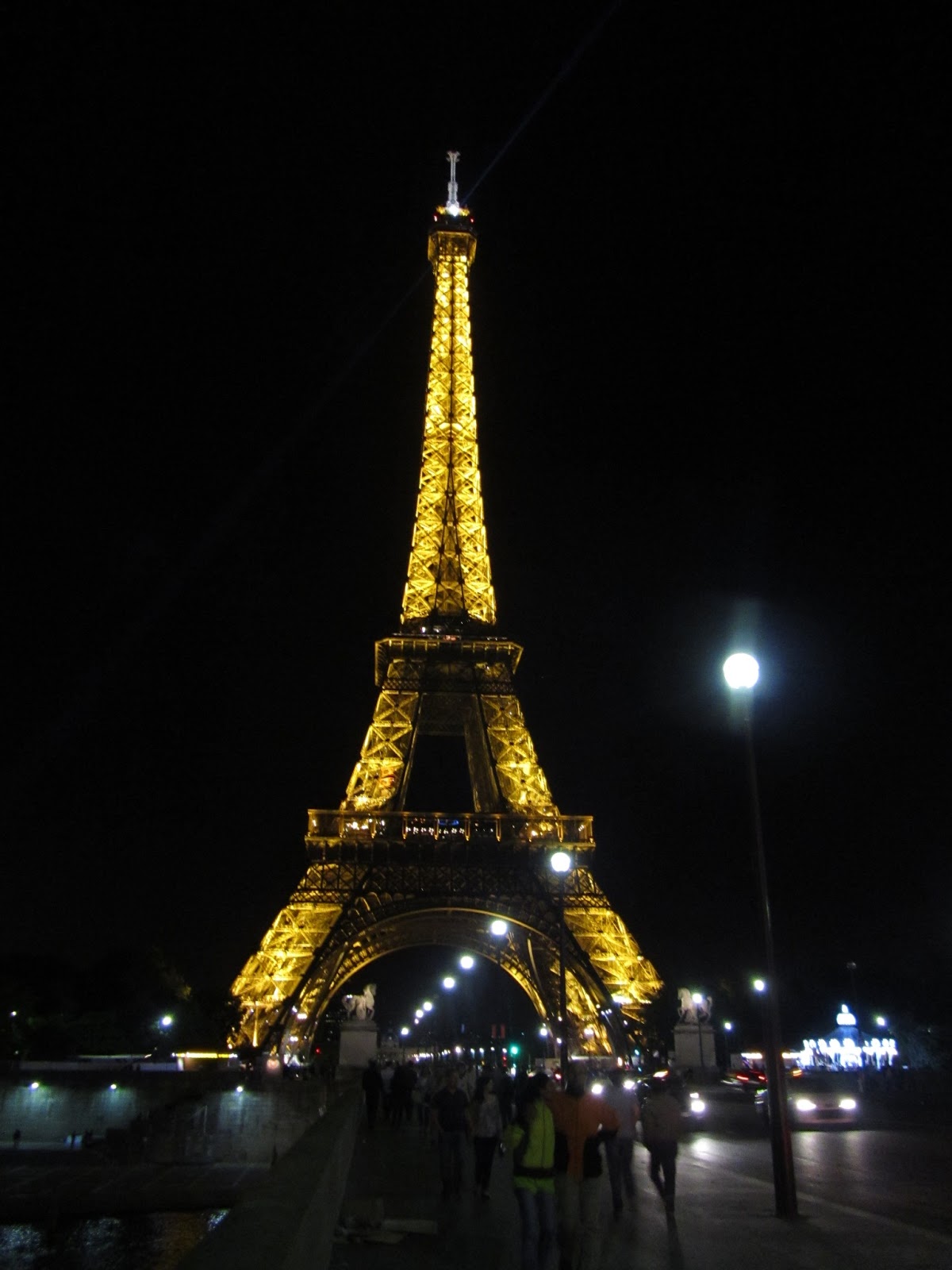
We walked through the gardens and the courtyard of the Louvre, admiring the intricate details of the grand architecture, but in as I'd been inside the museum on my last visit to Paris, and we are both very interested in impressionist and post-impressionist art, we opted to spend a day exploring the much more manageable Musée d'Orsay. We did the same with Notre Dame, the Arc de Triumph and the Eiffel Tower - admired each from the ground without paying to go in or up.

The morning of Friday the 20th of May, we met my parents at Gare du Nord and checked into our new hotel. After a brief time to settle in, we began our week-long historical voyage.

Throughout my childhood, many of our vacations involved either the family hobby of historical re-enacting, or visits to colonial forts and battlefields from every North American war or a combination. This would be no different. (Although at 24, I certainly enjoy and seek out these sites and museums more than I'd once thought I would. For me thirteen-year-old self, this would have been a painful trial)

In the hall of mirrors
We started by visiting the tomb of Napoleon at the Musée d'Armée, taking in as well the exhibits of medieval suits of armour. Our final day in Paris, leaving Dan behind nursing a cold, we ventured out to the palace of Versailles. The first part of the afternoon, I spent with my Mom and Dad wandering through the elaborate, never-ending splendor of the gardens. We wandered through the series of small gardens, sheltered by hedges and each centered on a sculpted fountain, through the breezy tree-lined boulevards, and by the giant expanse of the grand canal. I left them to enjoy the whimsical madness of Marie Antoinette's fake peasant village while I made my way back to the palace to find Dan. We explored the palace in the late afternoon - unbelievably elaborate, crowned by the hall of mirrors, dazzling in its excess with hundreds of gold-rimmed mirrors and gold-covered statues, throwing the light around the room to beautiful effect.

The next morning, we picked up a car at Gare du Nord. Although this time it was Dad driving, I was back in the navigator's seat with my trusty atlas of France in my lap - thankfully, though, sandwich making duties had now been delegated to the back seat. With minimal agony we found our way out of Paris and we were headed northwest to Normandy.

S.